

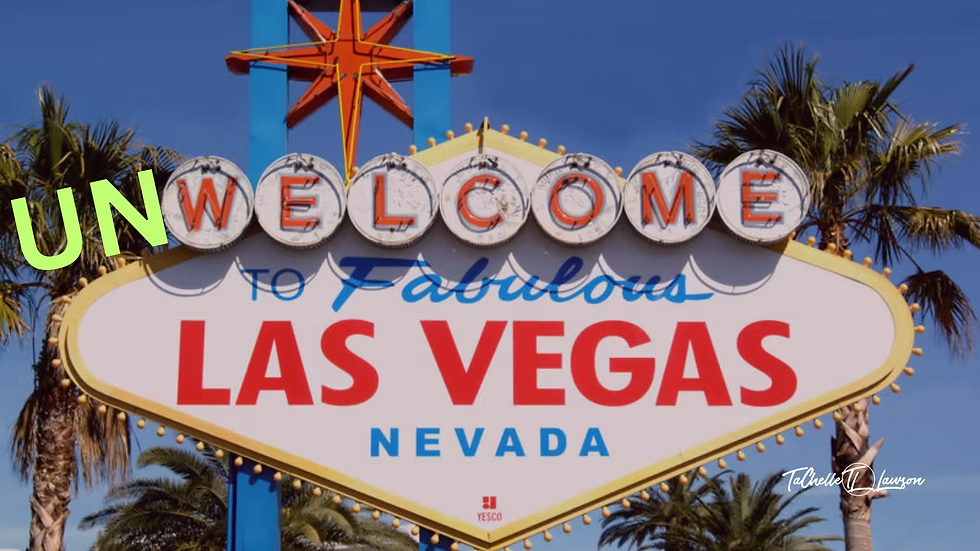
(UN)Welcome to Las Vegas
- TaChelle Lawson
- Sep 16
- 3 min read
Where Now the House Loses
I grew up in Las Vegas in the 90s. My dad cooked in a casino, and my mom worked as a hostess. Hospitality is part of my culture.
I remember the all-day Christmas parties hotels threw for employees and their families. Ballrooms filled with activities for every shift, day, swing, and graveyard. Every Thanksgiving meant a turkey. Every Christmas, a ham. One year, the kids all got sleeping bags. For my sisters and me, that was magic. We’d roll them out in our living room and pretend we were anywhere but our neighborhood in Northtown. That was Vegas: a city that took care of its people.
Even as a teenager, hospitality was the throughline. My friends and I would regularly hit the Silver Nugget for their $2.22 Hungry Man breakfast. Eggs, pancakes, sausage, bacon, toast, hashbrowns. We paid for the food but also got the kindness of a waitress who asked about our night, kept our soft drinks filled, and teased along with us. She gave us a reason to come back.
That Vegas is gone.
Of course, the $2.22 Vegas wasn’t sustainable. Nobody was getting rich giving away all-you-can-eat buffets and midnight breakfasts at cost. But when the city shifted, it did so smartly.
In the early 2000s, Vegas attracted a new customer. Mid-20s and 30s with disposable income who wanted something elevated. They knew they’d pay more, but the experience made it worth it. Bottle service, fine dining, luxury suites, you got something extra for the extra dollars.
That’s what’s changed. Today, the cost has soared, but the experience hasn’t kept pace. In fact, it’s gone backward. Hotels cut service. Airlines cut legroom and meals. Companies replace human support with bots, then still charge premium prices. Across industries, leaders are chasing margin by stripping value and customers know it.
Today, you can spend $700 on dinner and still get dinged $36 to park your car. A hotel room runs $500 with another $150 in resort fees. A bottle of water is $20. A beer at Allegiant Stadium? $36. And yet the president of the LVCVA insists, “Vegas is doing fine.”
Vegas hospitality is not doing fine.
Welcome to Vegas
Vegas used to be about hospitality. Now it’s about extraction. You’re no longer a guest, you’re an ATM.
The old promise was simple: come here and be taken care of. Now the message is: come here and pay for the privilege of being overcharged. The cultural contract is broken. And when culture collapses, customers don’t argue. They leave. Empty casino pits and quiet hotel floors prove it.
Vegas is experiencing the fallout of broken culture in real-time.
Reputation Roulette
Executives are gambling that customers will tolerate more fees and less service. But every spin of that wheel carries risk. The higher the extraction, the greater the chance customers decide they’ve had enough.
The reputation of Las Vegas was built on indulgence, escape, fun and excitement. Now the story is $200 buffets, $100 parking, and TikToks explaining why Vegas isn’t worth it anymore. Once trust breaks, no amount of comps or ad campaigns can put it back together.
The Outrage Economy
And when Vegas stumbles, outrage pays. Travel bloggers, influencers, TikTokers, and national media feast on stories of gouging. One viral clip about resort fees reaches millions and reinforces the new narrative: Vegas is no longer about hospitality. It’s about greed.
The city can release as many “new ad campaigns” as it wants, but it’s spin. Customers have already written the counter-story and they’re amplifying it louder than the LVCVA.
Las Vegas is a mirror for every American brand right now. Airlines, hotels, retailers, and tech companies are all playing the same game: raise costs, strip value, spin the story. It’s short-term greed at the expense of long-term trust.
Las Vegas was once the gold standard of customer experience. Today, it’s a warning: break the customer contract, and eventually, the house loses.
Welcome to Vegas, everyone. A new Las Vegas.
Comments